

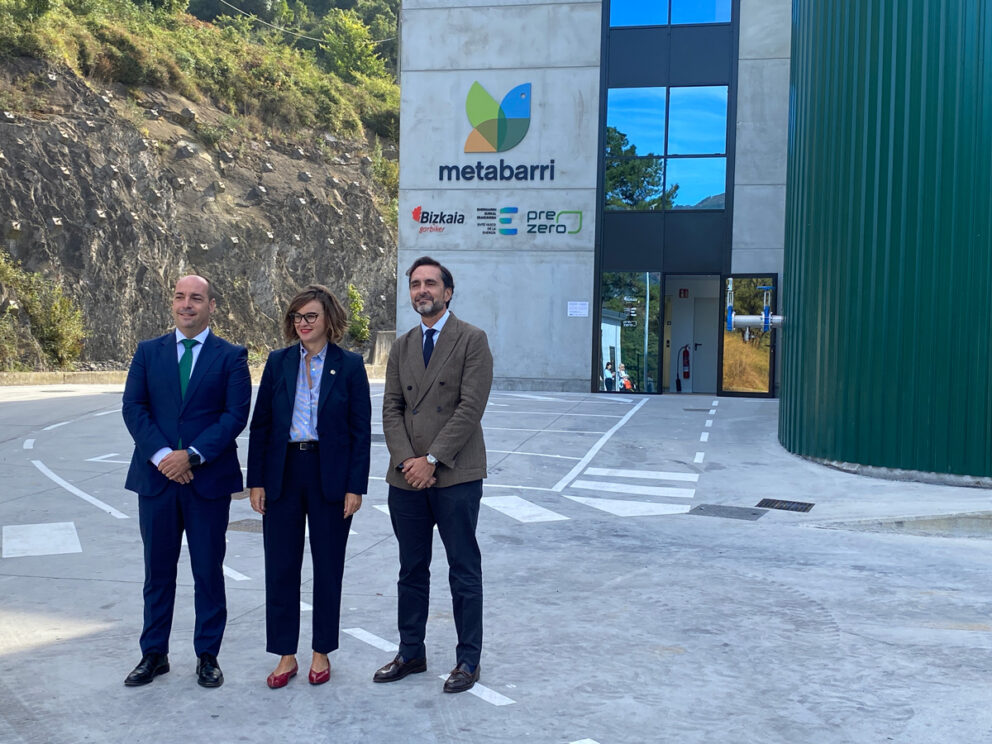
The installation, promoted by a public-private partnership formed by the Provincial Council of Bizkaia, EVE and PreZero, carries out in the same space the whole process from the treatment of organic waste to the obtaining of biomethane prepared for its injection in the gas network.
The Provincial Council of Bizkaia, through the foral society Garbiker, the Basque Energy Agency (EVE) and PreZero have today inaugurated Metabarri, the new biomethanization plant located in the Ecoparque de Artigas that will transform organic waste collected selectively into renewable gas called biomethane. The facility is the first in the State with a public-private partnership and carries out in the same space the entire process from the reception and treatment of organic waste to the obtaining of biomethane prepared to be injected into the natural gas transport network. In this way, the waste deposited in the brown container can be entirely transformed into a renewable energy source.
The infrastructure began its testing phase in June and will start receiving the first waste at the end of this month to progressively start its activity.
The opening ceremony was attended by the Deputy General of Bizkaia, Elixabete Etxanobe; the Director General of the Basque Energy Agency (EVE), Mikel Amundarain; and Borja Martín Zorita, Business Development Director of PreZero, who visited the facilities and knew first-hand the different phases of the process.
Metabarri has involved an investment of 25 million euros, having received a grant of more than 17 million euros from the Next Generation funds. In addition, it occupies an approximate area of 8,300 square meters next to the current composting plant of the Ecoparque de Artigas. Its implementation will respond to the expected growth of the selective collection of organic matter through the brown container in the coming years.0
During the inauguration, Elixabete Etxanobe stressed that “Metabarri represents very well the Bizkaia we want to build: a territory that converts its waste into resources such as compost and that generates renewable energy in anticipation of the challenges of the future. This plant will transform up to 50,000 tons of organic matter per year and demonstrates that the circular economy is not just a goal: it is a reality that we are already putting in place.”
For his part, the general director of the Basque Energy Agency, Mikel Amundarain, said that “this plant is a new step in the construction of a cleaner, more efficient and more sustainable energy system for the Basque Country because it contributes to the effective decarbonization of numerous industrial consumptions. We need to produce more renewable energy to supply us and all the projects are valid, both the large wind facilities and the small solar panels on the roofs. Everything contributes. And the Basque Country is taking decisive steps in this objective, as is the case of the EVE Map, which identifies the best locations with the greatest potential of future renewable facilities to enhance their development. In addition, the project is fully aligned with the 2030 Industry Plan of the Basque Government, it will be key to promote the use of new energy solutions in the industry, especially in those sectors of difficult electrification.
Metabarri demonstrates that we have the necessary technological, industrial and institutional capacity to develop innovative and transformative projects that place us at the forefront of the Energy Transition. This plant takes another step towards a more sustainable, more competitive and more energetically autonomous Basque Country.”
Borja Martín Zorita, Business Development Director at PreZero, stressed that “for decades, this land has been one step ahead to stay at the forefront in the circular economy. The plant that we inaugurate today is a new example of technology and innovation in that long trajectory of continuous improvement. A pioneering installation as a result of public-private collaboration that demonstrates once again that together we can achieve many more things. At PreZero, we are ready and willing to continue accompanying Bizkaia on the road to a better economic and environmental future.”
Growth of the brown container
The construction of Metabarri responds to the need to adapt the treatment infrastructures to the increase of the selective collection of the organic fraction. The Comprehensive Plan for Prevention and Management of Local Competition Waste of Bizkaia 2030 (PIPGRB 2030) proposes to continue advancing in the separation and use of these waste and to minimize those that end up being eliminated.
The new plant will treat up to 50,000 tons of organic matter per year, complementing the capacity of existing composting facilities in Bizkaia, including Bizkaiko Konpostegia and the county plants.
In this way, the organic remains deposited by homes and establishments in the brown container can become a new source of renewable energy. Metabarri will thus make it possible to move towards a model in which waste is once again converted into resources.
Once at full capacity, the plant will be able to generate an amount of energy equivalent to the consumption of around 12,700 homes per year. The use of biomethane obtained will also reduce greenhouse gas emissions by up to 95% compared to those associated with the use of fossil fuels.
From the brown container to the material and energetic valuation
The process begins with the organic waste collected in the brown container. These wastes are broken down into large closed tanks and generate biogas. That gas is then purified to biomethane, a renewable gas with characteristics similar to those of natural gas and prepared to be incorporated into the natural gas transmission and/or distribution network. In the case of Metabarri, it is the transport network of Enagás Transportes del Norte (ETN) in which the Ente Vasco de la Energía participates.
Thus, food waste and other organic waste can go from being a waste to becoming a local source of renewable energy, contributing both to a more efficient management of waste and to the reduction of fossil fuel consumption.
The process also makes it possible to take advantage of the material that remains after obtaining the gas. This material is subsequently treated to produce compost, so that the organic matter has a double exploitation: it is used to generate renewable energy and, subsequently, to obtain a product that can be reused as fertilizer.
Main benefits of Metabarri
The production of biomethane from organic waste brings different advantages:
- It turns waste into renewable energy. The organic matter collected in the brown container is used to produce a gas of renewable origin.
Reduce the use of fossil fuels. Biomethane can replace fossil-based gas and thus contribute to reducing greenhouse gas emissions and our energy dependence. - It produces energy in a stable way. Its generation does not depend on factors such as the sun or the wind and allows a continuous source of renewable and manageable energy to be available.
- Make better use of the energy generated. The transformation of biogas into biomethane makes it possible to achieve an energy yield close to 90%, compared to about 40% of its use to produce electricity.
- It can be used through the existing natural gas network. Biomethane can be incorporated into the network and reach homes, shops, industries or uses linked to mobility without the need for changes in the facilities of users.
- Optimizes the production of compost. The pre-treatment of organic matter in Metabarri allows to speed up the subsequent process in Bizkaiko Konpostegia and to double its organic matter treatment capacity.
It generates energy of local origin. Metabarri uses waste generated in Bizkaia to produce renewable energy and helps reduce dependence on fuels from abroad.


