

The moving water in rivers and streams is an abundant source of energy, which has been harnessed since earliest times.
For many centuries, human history has run in parallel to the development of water-powered machinery. The Egyptians are thought to have been the first people to make use of waterpower, some 5000 years ago. The Romans in turn developed the water wheel or Roman watermill. The system was gradually improved in the Middle Ages, enabling it to be used in the textile and metallurgical industries. In the nineteenth century, water-driven turbines were invented. Today, hydroelectricity is one of the most important and efficient forms of renewable energy.

Efficiency 30%

Efficiency 75%
How a small hydro station works
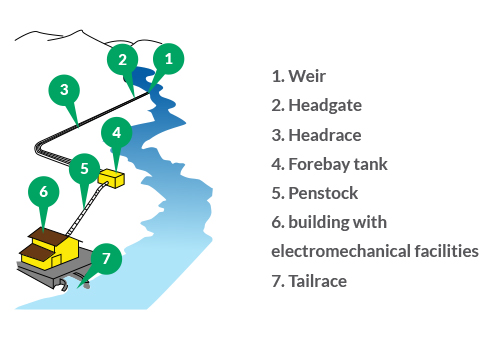
A small hydro station consists of a set of hydraulic installations (a weir or dam, channel, pipes, etc.) and electromechanical equipment (turbines, generators, power system, etc.) needed to transform the kinetic energy of the water into electricity. The ultimate purpose is to turn the falling water first into mechanical energy and then into electricity, by means of generators. When the water passes through the turbine, it drives a runner, causing the shaft to which it is attached to rotate.
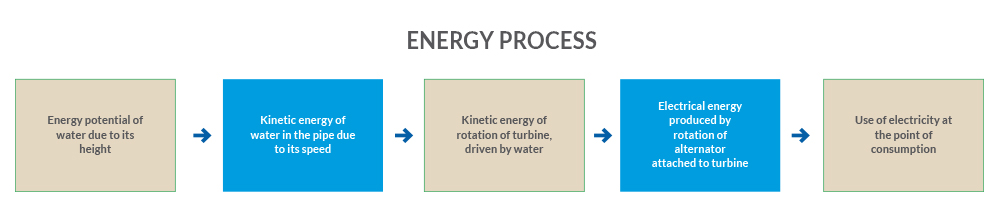
The amount of energy generated is a function of the quantity of water passing through the turbine in a given unit of time (the flow) and the difference in level between the point from which the water is taken and the point in the river at which the water is returned after use (the head).
The electrical power of a small hydro station can therefore be expressed as:
P = 9,81 ˑ Q ˑ H ˑ ɳ
Where:
- P : is the power in kW
- Q : is the flow rate in m³/s
- H : is the head in m
- ɳ : Efficiency (turbine, generator, transformer)
Types of turbine
Turbines are designed to obtain the greater efficiency at each specific location depending on the flow rate of the water to be harnessed and the available head. As a result, such machines are not mass produced. According to requirements, there are different types of turbine with major differences both externally (dimensions and appearance) and internally (components). The following are some of the most important types:
- Pelton (for high heads, independently of the variation in flow rate),
- Francis (for a wide variety of heads and moderate variations in flow rate),
- Kaplan (for low heads and large flow rates).
The graph below can be used to select the type of turbine depending on the flow rate and head.

The runner is the part of the turbine on which the water exerts pressure, thus forcing the shaft to which it is attached to rotate and in turn driving the electric generator. Runners come in many forms, depending on the type of turbine on which they are mounted.

Types of runner used in different turbines
Advantages of hydro power
Hydroelectricity is one of the most widely used renewables because of its clear advantages, especially compared to fossil energy and other non-renewables.
- It is a clean energy source that uses water as «fuel» to generate electricity. The water used in the process is not consumed; it is simply taken from one point in the river and returned to another point further downstream.
- It does not generate any heat and emits not atmospheric pollutants This means that it does not pollute the air (through acid rain, the greenhouse effect, etc.), or emit hazardous waste during generation, since it involves no chemical transformation.
- It is an inexhaustible source of renewable energy, since it uses the natural cycle of the water.
- It is safe for wildlife.
- Generating capacity is reliable and in the case of impoundment plants installed in reservoirs, the flow and energy can be regulated.
The energy generated is environmentally-friendly and the impact is small. Nonetheless, appropriate measures have to be taken to minimise such impact (fish ladders, ecological flows, incompatibility of 'peak' flows, etc.).


