

Geothermal and Aerothermal Energy for efficient HVAC systems
Heat pumps use renewable sources such as the air (aerothermal energy) and ground heat (geothermal energy) to heat and cool homes and other buildings efficiently, sustainably and economically.
What is a heat pump?
A heat pump is a device capable of extracting thermal energy (heat) from its surroundings (in the air or ground) and transferring it to the inside of a building to provide heating, cooling and domestic hot water. It is a modern and environmentally-friendly alternative to traditional boilers.
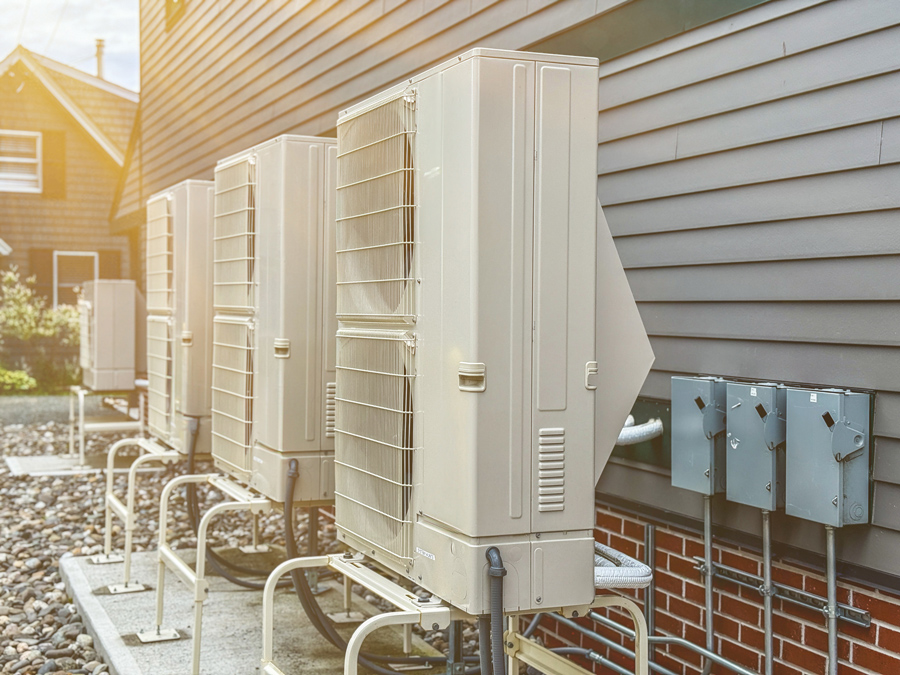
Aerothermal energy: harnessing the energy from the air
How does it work?
Aerothermal energy systems use air-to-water heat pumps to extract thermal energy from the outside air, even on cold days. They then transfer that heat to the interior of the building for use in heating, cooling and domestic hot water.
Primary benefits:
- • Clean, renewable energy: Air source heat pump (ASHP) systems use air as their energy source, thus reducing carbon emissions.
- • High efficiency: for every kW of electricity consumed, ASHPs can generate between 2 and 3 kW of thermal energy, depending on the outside temperature.
- • All-in-one HVAC: ASHPs are suitable for installation in houses, apartments and office buildings.
- • Flexible installation: se adapta a viviendas unifamiliares, pisos y edificios de oficinas.
- • Low maintenance and long service life.
- • Health and Safety: no combustion or fuel tanks.
- • Compatible with other renewable energy sources.
Where is it used?
ASHPs are ideal for new homes, renovations and condominiums. More and more homes and companies are opting for this technology.
Geothermal energy: harnessing heat from the ground
How does it work?
Geothermal energy takes advantage of the constant temperature below the earth’s surface (from a depth of 10 metres) using a buried water circuit. The system captures the heat from the ground and transfers it to the building via a heat pump.
Primary benefits:
- • Clean, renewable energy: reduces fossil-fuel dependence and carbon emissions.
- • High efficiency: for every kW of electricity consumed, more than 4 kW of thermal energy is obtained, at a stable ground temperature. Furthermore, it requires less electricity and a smaller power connection.
- • Temperature: the system obtains higher temperatures without requiring an electrical element.
- • Financial savings: up to 70% in heating and 50% in cooling, as compared to conventional systems.
- • Durable installations: service life in excess of 50 years with low maintenance.
- • Health and Safety: less noise since there are no fans. Lower volume of coolant.
- • Compatible with other renewable energy sources.
Where is it used?
Mainly in homes, buildings and some industrial processes. Installations in the Basque Country have given excellent results.
Comparison: Geothermal or Aerothermal?
| Characteristic | Aerothermal | Geothermal |
| Energy source | Energy from outside air | Underground heat |
| Efficiency | High (2–3 kW of heat per kW of electricity) | Very high (> 4 kW of heat per kW of electricity) |
| Installation | Easier installation | Requires boring |
| Electricity | Increase in power capacity to be contracted | Lower capacity, depending on efficiency |
| Maintenance | Low, long service life | Low, service life > 50 years |
| Noise | From fans | No noise |
| Initial investment | Smaller, can be paid back in a few years | Higher, payback period depends on energy demand |
Also, since geothermal pumps use a water circuit in the heat capture system, any residual heat generated can be used in industrial processes or for cooling buildings such as data centres.
Which one should I choose?
Both technologies are efficient, sustainable and help reduce energy consumption and emissions. The right choice will depend on the characteristics (i.e. energy demand) of the building, the land available and the budget. In either case, moving to heat pumps means moving to comfort, energy saving and greater environmental responsibility.


