

Technologies for managing demand and harnessing renewable power generation
Energy storage allows power generated from renewable sources and energy from industrial processes to be stored to be used later when it is technically or economically more advantageous. As a result, better use is made of the available renewable energy.
Broadly speaking, energy storage can take any of the following forms:
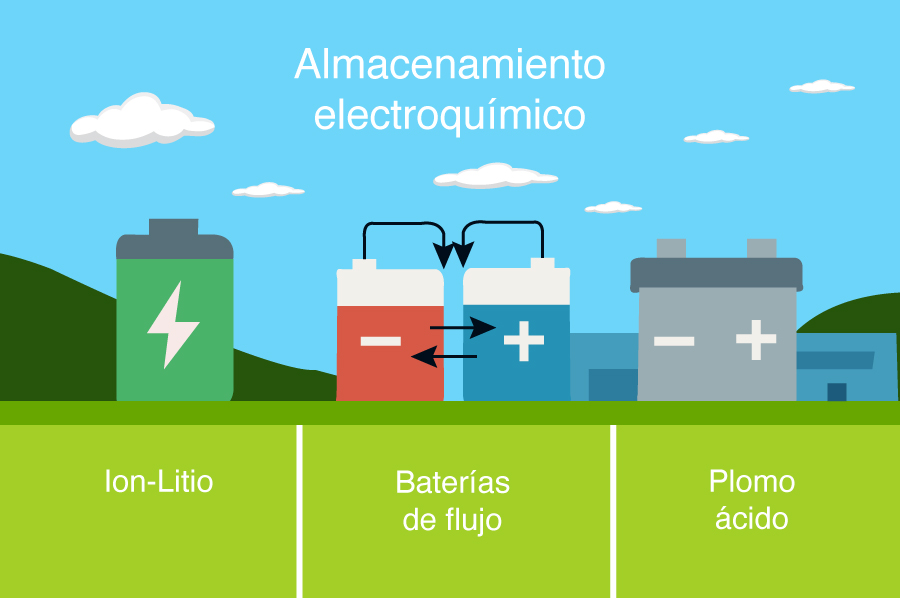
- • Electrochemical storage (battery storage) involves accumulating energy via chemical reactions. Batteries are widely used in buildings and heavy industry, in association with solar self-consumption facilities. They are also increasingly common in large solar farms. Typical the power is stored for various hours or days.
![almacenamiento electroquímicoa]()
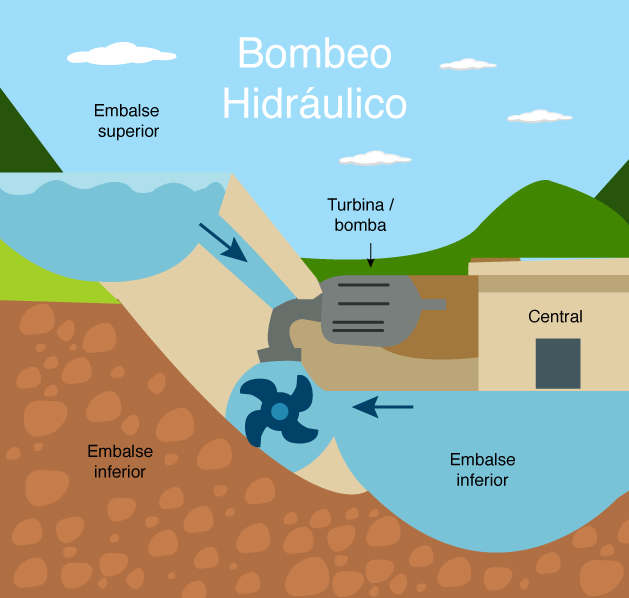
- • Pumped-storage hydroelectricity involves using surplus power to pump water from a lower reservoir to a higher one, from where it can be released to generate power via a turbine whenever needed. Pumped-storage hydro facilities are usually built on a large scale and are used for long-term energy storage — days, weeks or even months.
![Bombeo hidráulico]()
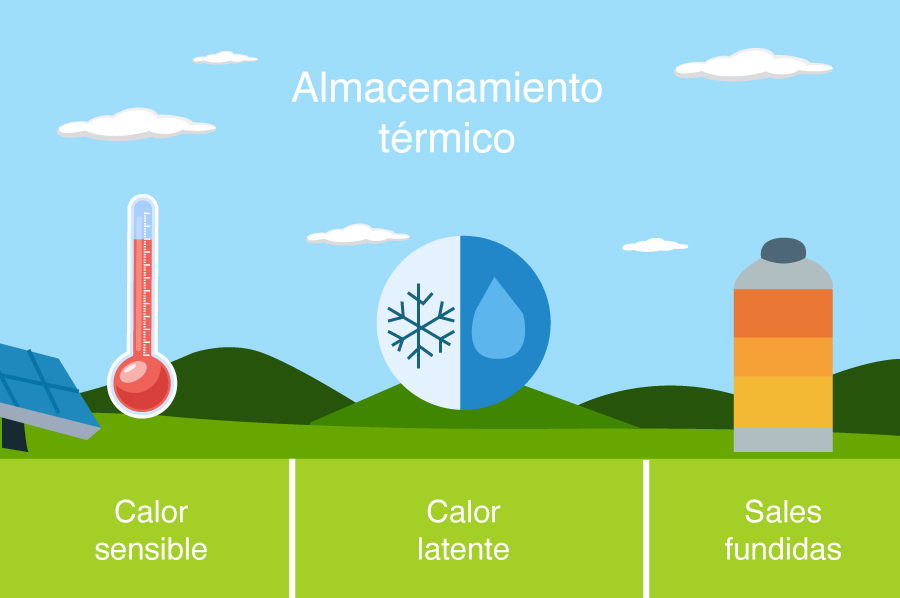
- • Thermal energy storage facilities store heat or cold for later use, e.g. in industrial processes or HVAC (heating, ventilation and air conditioning) systems. They include:
- o Latent heat systems, which use the heat absorbed or released during phase transitions.
- o Sensible heat storage systems, which store energy by increasing the temperature of a material with no phase change.
- o Molten-salts-based systems are used for high-temperature sensible heat storage.
![Almacenamiento térmico]()
- • There are also other mechanical systems using devices such as flywheels and compressed air, which store energy in the form of motion or pressure. These systems are still at a pre-commercial phase.
Incorporating storage systems holds out great advantages and opportunities for the electricity system and end consumers alike:
- • They allow greater integration of renewables, reducing the impact on the grid of variations in the energy available from renewables.
- • They allow renewable power generation and power consumption to be uncoupled, thus facilitating operation and planning of the power system.
- • They open the way for greater economic savings for end consumers by reducing the amount of power they consume at the most expensive times of day.
- • Thermal storage improves the energy and economic efficiency of many industrial processes.
- • Pumped storage hydro plants provide synchronous power to the system, helping to make the grid more balanced and reliable.
In short, storage enables a more sustainable energy mix and lower emissions and is set to be a key element in the transition to a cleaner, more efficient and safer energy model.


